INDEX
Explore Yamaguchi City to Learn Both Japan's History and Contemporary Culture
Yamaguchi City has a rich and diverse history making it the cultural hub of modern Japan, surrounded by natural beauty.
Known for its stunning scenery, ancient castle towns, and beautiful beaches, Yamaguchi is a must-visit for travelers looking to experience Japan’s rich culture and history.
At the western tip of Honshu (Japan’s largest island) sits Yamaguchi Prefecture, with its unique natural landscape and vast forest sceneries. Surrounded by seas on three sides - the Sea of Japan, the Seto Inland Sea, and the Hibiki Sea - Yamaguchi’s long coastlines boast emerald green waters and beautiful sandy beaches. You’ll also see vast cliffs and oddly-shaped rocks eroded by raging waves.
Yamaguchi Prefecture, then known as Chosu, also played a vital role in the Meiji Restoration. It was the home of two prominent individuals, Yoshida Shoin and Takasugi Shinsaku, who became central figures in promoting the Meiji Restoration and played a crucial role in establishing Japan as it is today.
Hiroshima Station → Miyajima Island → Iwakuni City → Kintaikyo Bridge → Kashiwabara Art Museum → Kintaikyo Onsen
You’ll start at the eastern part of Yamaguchi Prefecture, close to Hiroshima. From Hiroshima Station, you can travel to Miyajima by train and ferry. Miyajima Island has been a foundation of Shintoism for thousands of years. The present shrine, Itsukushima, has several buildings that have been designated as National Treasures, and a part of the island is a UNESCO World Heritage site.
After your brief tour of Miyajima, you may take a train and bus to Kintaikyo Bridge in Iwakuni City, where you can explore on your own.
The Kintaikyo Bridge has been Iwakuni’s most prominent and iconic landmark for hundreds of years. From afar, you can see the five arches of this elegant wooden bridge as it crosses over the Nikishi River. It is considered one of the three most spectacular bridges in the country and makes Iwakuni worth visiting.
Furthermore, near Kintaikyo Bridge, you will find the Kashiwabara Museum of Art, which features Japanese samurai art and history. The museum houses approximately 6,000 items in its collection, showcasing a wide range of exhibits including National Treasures, Important Cultural Properties, artworks from the Nara to Edo periods, glassworks, ceramics, paintings, calligraphy, horse gear, and furniture. Visitors can experience the cultural value of Japanese armor and swords among other samurai artifacts. It is a popular sightseeing spot in Iwakuni, where you can also admire rare swords crafted by Gō Yoshihiro, a master swordsmith from the Nanbokucho Period.
After your tour, you may spend the night at a hotel in front of Iwakuni Station or a ryokan in Kintaikyo Onsen. There is a hot spring inside Iwakuni Kokusai Kanko Hotel, a three-minute walk from Kintaikyo Bridge. They feature two kinds of baths, the first of which is the "Morning Mist Bath" (Asagiri no yu), which overlooks Kintaikyo Bridge. The second is the "Evening Mist Bath" (Yuugiri no yu), where bathers can gaze at Iwakuni Castle and the mountain beyond it.
Iwakuni Station → Yanai Station → Furuichi/Kanai District → Shin-Yamaguchi Station → Yuda Onsen → LAWAKU → Overnight stay at Yuda Onsen
On the next day, you can go from Iwakuni Station to Yanai Station to walk through the white-walled streets in the Furuichi and Kanaya districts of Yanai City. Located just 10 minutes from Yanai Station, this particular district in Yanai City feels like stepping back into the Edo Period.
The stone-paved streets are lined with white-walled merchant houses with tile roofs, specially constructed by covering the walls with mud using the dozozukiri method. During the Edo Period, it was a flourishing street called the storage room of the Iwakuni Domain. Every August, the streets come to life during the Yanai Goldfish Lantern Festival.
After exploring the white-walled townscape, you can head to Yuda Onsen in Yamaguchi City. This is where you will spend the night after exploring the area.
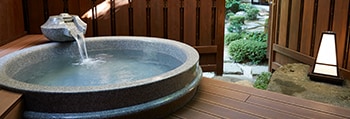
The hot springs in Yuda Onsen are known to have the richest water in the Sanyo region. Surrounding these healing alkaline springs is a legend about a wounded white fox who healed its body by bathing in Yuda Onsen’s hot springs.
If you don’t feel like soaking your whole body, you can try the free foot baths around town. One of the best places to go is a facility called Kitsune no Ashi Ato (Yuda Onsen Welcome Square (Paid/admission fee required)), where you can enjoy foot baths while dressed in a traditional kimono. You’ll also find a private garden where you can try coffee, sake, and various Japanese desserts.
Close to Yuda Onsen is LAWAKU, where you can enjoy Japanese culture by making traditional Japanese sweets (nerikiri), wearing a kimono, and enjoying Japanese tea culture. There are different packages for you to choose from.
Don a traditional kimono while experiencing Japan’s unique tea culture. You’ll also learn how to make traditional Japanese sweets. Take a lot of photos and enjoy the peaceful atmosphere the cafe creates.
• Duration: 1 hour and 30 minutes
• Price Includes: Experience fee, Japanese sweets, green powdered tea, English-speaking guide
This simple plan allows you to experience Japanese tea ceremony culture with ease.
• Duration: 40 minutes
• Price Includes: Experience fee, Japanese sweets, green powdered tea, English-speaking guide
• Venue: LAWAKU (13-45 Shimoichi-cho, Yamaguchi City, Yamaguchi Prefecture 753-0058)
• TEL:+81-83-902-6454
• Opening hours: Weekdays 9:30 a.m. to 4 p.m.; Saturdays, Sundays & holidays 9:30 a.m. to 5 p.m.
• Closed: Every Tuesday; irregular holiday closures may apply
Yuda Onsen → Kozan Park | Rurikoji Temple Five-Story Pagoda→ Shin Yamaguchi Station or Yuda Onsen → Hagi Okan Road Tour → Yamaguchi-Ube Airport for your flight back
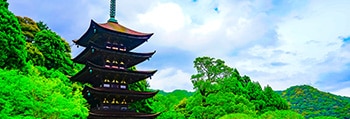
On the third day, you may want to visit the Rurikoji Temple Five-Story Pagoda, a national treasure 10-minutes from Yuda Onsen. Commissioned by Ouchi Moriharu, the pagoda was to serve as a memorial for his older brother, Ouchi Yoshihiro, who lost his life in the battle of Oei. With its sharp, thatched cypress roofs, the pagoda’s architectural style is partly Japanese, and partly Chinese.
Now a national treasure, this five-story pagoda is considered one of Japan’s top three greatest temples, alongside Horyuji Temple near Nara and Daigoji Temple in Kyoto. Located in Kozan Park, Rurikoji Temple Five-Story Pagoda features the main hall, a temple storehouse, a bell tower, and a small museum explaining other five-story pagodas around Japan.
After seeing Rurikoji Temple, you may head to Yamaguchi-Ube Airport for your return trip or go on a guided tour along a 400-year-old historic road.
The Hagi Okan is an old road connecting Hagi City on the Sea of Japan and Mitajiri Port in Hofu City on the Seto Inland Sea. This route was very important during the Edo Period, as it connected Sanin (southwest area of Honshu) and Sanyo (southern area of Honshu).
You’ll also get to see the ruins of a teahouse and the ruins of a gatehouse once used to control the flow of travelers.
• Meeting Place: Yamaguchi Station
• Duration: 3 hours and 30 minutes
• Price Includes: English-speaking guide
Traveling to Yamaguchi is easy from Japan’s major cities.
You can fly from Tokyo to Yamaguchi. With the JAL Japan Explorer Pass, it only takes 90 minutes to Hiroshima Airport and 100 minutes to Yamaguchi-Ube Airport.
If you’re traveling from Hiroshima, you can ride the Shinkansen, which only takes about 30 minutes.
Hagi is a former castle town in Yamaguchi Prefecture, famous for Hagiyaki Pottery, which ranks among Japan’s best. Its well-preserved sightseeing district features old samurai and merchant houses and other residences of famous historical figures.
Delectable dishes, enchanting castle towns, and unique cityscapes await travelers willing to explore this destination tucked at the bottom of mainland Japan. Compared to Tokyo or Kyoto, its less-crowded atmosphere makes it a more peaceful place to visit. There is a lot to discover, and you can take your time exploring one place after another without worrying about there being too many tourists.
Travel to Yamaguchi with the JAL Japan Explorer Pass.
Yamaguchi City has a rich and diverse history making it the cultural hub of modern Japan, surrounded by natural beauty.
Yamaguchi Prefecture is full of natural beauty. Visit the Akiyoshidai Plateau to explore the ancient sea bottom or head underground to spelunk in caves.
Get to know Yuda Onsen - Yamaguchi Prefecture’s premier hot spring destination - and its Japanese cultural experiences. Book your journey with JAL today.
Share
SHARE